728x90
동적 프록시 기술을 사용하면 개발자가 직접 프록시 클래스를 만들지 않아도 된다. 이름 그대로 프록시 객체를 동적으로 런타임에 개발자 대신 만들어준다. 그리고 동적 프록시에 원하는 실행 로직을 지정할 수 있다
- 주의
- JDK 동적 프록시는 인터페이스를 기반으로 프록시를 동적으로 만들어준다. 따라서 인터페이스가 필수이다.
AInterface
public interface AInterface {
    String call();
}
AImpl
@Slf4j
public class AImpl implements AInterface{
    @Override
    public String call() {
        log.info("A 호출");
        return "A";
    }
}
BInterface
public interface BInterface {
    String call();
}
BImpl
@Slf4j
public class BImpl implements AInterface{
    @Override
    public String call() {
        log.info("B 호출");
        return "B";
    }
}
예제 코드
JDK 동적 프록시에 적용할 로직은 InvocationHandler 인터페이스를 구현해서 작성하면 된다.
동적 프록시 적용 코드
@Slf4j
public class TimeInvocationHandler implements InvocationHandler {

    private final Object target;

    public TimeInvocationHandler(Object target) {
        this.target = target;
    }

    @Override
    public Object invoke(Object proxy, Method method, Object[] args) throws Throwable {
        log.info("TimeProxy 실행");
        long startTime = System.currentTimeMillis();
        Object result = method.invoke(target, args);
        long endTime = System.currentTimeMillis();
        long resultTime = endTime - startTime;
        log.info("TimeProxy 종료 resultTime={}", resultTime);
        return result;
    }
}- TimeInvocationHandler 은 InvocationHandler 인터페이스를 구현한다. 이렇게 해서 JDK 동적 프록시에 적용할 공통 로직을 개발할 수 있다.
- Object target : 동적 프록시가 호출할 대상
- method.invoke(target, args) : 리플렉션을 사용해서 target 인스턴스의 메서드를 실행한다. args는 메서드 호출 시 넘겨줄 인수이다
동적 프록시 실행 클라이언트 코드
@Test
public void dynamicA() {
    AInterface target = new AImpl();
    TimeInvocationHandler handler = new TimeInvocationHandler(target);
    AInterface proxy = (AInterface) Proxy
        .newProxyInstance(AInterface.class.getClassLoader(), new Class[]{AInterface.class},
            handler);
    proxy.call();
    log.info("targetClass={}",target.getClass());
    log.info("proxyClass={}",proxy.getClass());
}

@Test
public void dynamicB() {
    BInterface target = new BImpl();
    TimeInvocationHandler handler = new TimeInvocationHandler(target);
    BInterface proxy = (BInterface) Proxy
        .newProxyInstance(BInterface.class.getClassLoader(), new Class[]{BInterface.class},
            handler);
    proxy.call();
    log.info("targetClass={}",target.getClass());
    log.info("proxyClass={}",proxy.getClass());
}- new TimeInvocationHandler(target) : 동적 프록시에 적용할 핸들러 로직이다.
- Proxy.newProxyInstance(AInterface.class.getClassLoader(), new Class[] {AInterface.class}, handler)
- 동적 프록시는 java.lang.reflect.Proxy를 통해서 생성할 수 있다.
- 클래스 로더 정보, 인터페이스, 그리고 핸들러 로직을 넣어주면 된다. 그러면 해당 인터페이스를 기반으로 동적 프록시를 생성하고 그 결과를 반환한다.
실행 순서
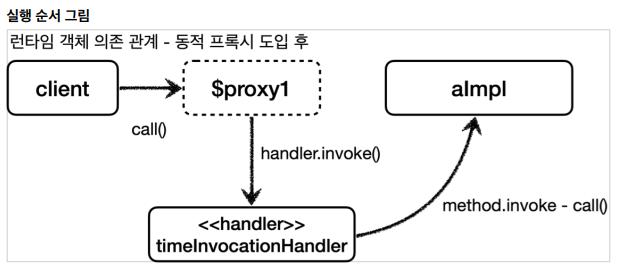
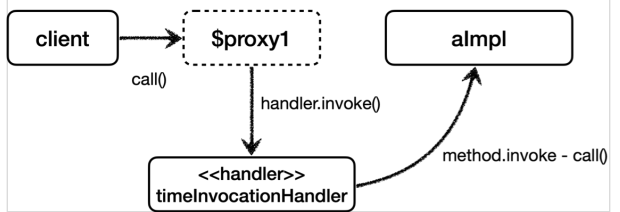
- 클라이언트는 JDK 동적 프록시의 call()을 실행한다.
- JDK 동적 프록시는 InvocationHandler.invoke()를 호출한다. TimeInvocationHandler 가 구현체로 있으로 TimeInvocationHandler.invoke()가 호출된다.
- TimeInvocationHandler 가 내부 로직을 수행하고, method.invoke(target, args) 를 호출해서 target 인 실제 객체( AImpl )를 호출한다.
- AImpl 인스턴스의 call() 이 실행된다.
- AImpl 인스턴스의 call() 의 실행이 끝나면 TimeInvocationHandler로 응답이 돌아온다. 시간 로그를 출력하고 결과를 반환한다.
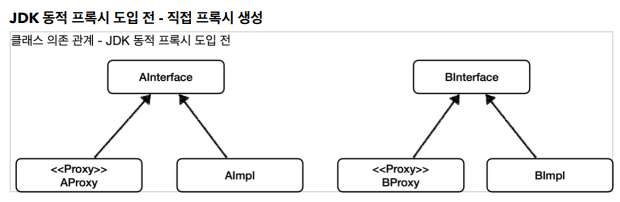
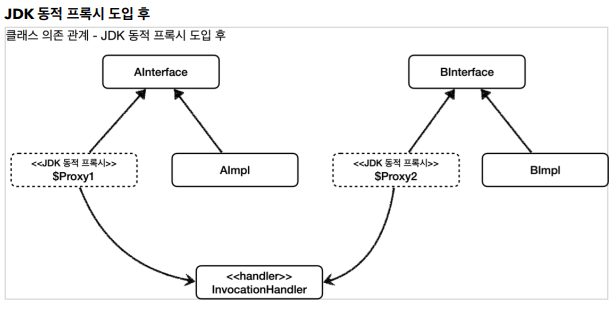
JDK 동적 프록시 기술 덕분에 적용 대상만큼 프록시 객체를 만들지 않아도 된다. 그리고 같은 부가 기능 로직을 한 번만 개발해서 공통으로 적용할 수 있다. 만약 적용 대상이 100개여도 동적 프록시를 통해서 생성하고, 각각 필요한 InvocationHandler 만 만들어서 넣어주면 된다
결과적으로 프록시 클래스를 수 없이 만들어야 하는 문제도 해결하고, 부가 기능 로직도 하나의 클래스에 모아서 단일 책임 원칙(SRP)도 지킬 수 있게 되었다
도입 전

도입 후
728x90
'스프링 핵심 원리(고급편)' 카테고리의 다른 글
| Ch05. 동적 프록시 기술 - CGLIB (0) | 2022.04.11 |
|---|---|
| Ch05. 동적 프록시 기술 - JDK 동적 프록시(적용) (0) | 2022.04.11 |
| Ch05. 동적 프록시 기술 - 리플렉션 (0) | 2022.04.11 |
| Ch04. 프록시 패턴과 데코레이터 패턴 - 인터페이스 기반 프록시와 클래스 기반 프록시 정리 (0) | 2022.04.10 |
| Ch04. 프록시 패턴과 데코레이터 패턴 - 구체 클래스 기반 프록시(적용) (0) | 2022.04.10 |